Lent Reflection and prayers – Pippa Bonner

The last time I wrote a Lent Reflection for Growing Old Grace-fully we were in the throes of the Covid global pandemic. Now we see war and struggles around the world in Ukraine, Gaza, the West Bank and Israel, the Sudan, Nigeria, and so many countries globally. Each is unique in its context but the suffering, injury and loss of life have universal similarities in the way people are hurting, deeply worried, struggling for meaning and wondering how to continue.  Climate change, conflict, and poverty are combining to drive people from their homes. Nationalism and racism seem to be increasing. Love and compassion are evident, but hard line rhetoric is threatening community dialogue and discouraging diverse communities from working out daily life issues together. 

It need not be like this…

Perhaps this Lenten Season is a time to reflect on how we each travel with Jesus on his Way to Jerusalem to Calvary, and the hope of His Resurrection. Reflecting too closely on how governments and political leaders are responding may be too painful at times. Instant news means we know almost immediately what is happening. We now have to factor in possible fake news and the toxic culture that exists in parts of the Internet. BUT, as adults, we also need to discern, pray and act in a way that leads to God and Resurrection.

As Micah wrote “And what does the Lord require of you? To act justly and to love mercy and to walk humbly with your God.” (6:8) ( New International Version )

Desert Experience

Jesus went into the desert at the start of his ministry. It was a time of isolation, hardship and temptation. A time to reflect and prepare for ministry. Perhaps our Lent journey leads us into a desert: a place alone to concentrate on God and abstain from comfort and distraction.

The Desert Mothers and Fathers lived during the 3rd to the 5th centuries in Egypt and the Middle East. They lived “a white martyrdom” where they left their communities, led a solitary ascetic life of poverty and self denial, whereas “a red martyrdom” meant losing their lives for God. Monasticism developed from these “white martyrs” as hermits tended to attract disciples and subsequently communities.

I go to North Wales to a Retreat Centre most years where a number of us learn about the local Celtic Saints. Amongst these, Saints Beuno, Seiriol, Winifred and Melangell lived a “white martyrdom” as hermits: a radical life of poverty, solitude and prayer, until followers sought them out and baptismal communities grew around them. There are many stories of saints continuing to seek solitude and escape at times from community life. It is believed that after finding St Seiriol’s Island (Puffin Island) and Anglesey too crowded, St Seiriol would set off at low tide to Penmaenmawr on the North Wales coastline opposite, up towards the area of Noddfa, the Retreat Centre where I stay! I am constantly aware of “Holy ground” when I am there. On Lindisfarne, St Cuthbert would do the same, spending time alone on a tiny island off the Northumbrian Coast and finally one of the Farne Islands. 

How do we manage or even value time alone?

Some of the Celtic Saints talked about the desert experience of being at the top of a mountain, or by the sea or on the sea: remote places where they could live and pray or wander. 

Might we think about those places in that way too?

Some saints like the 5th century Irish St Brendan was a sea explorer searching for the Promised Land. St Samson, another 5th century Saint, sailed between Ireland, Wales, Cornwall and Brittany, the route of other Celtic Saints. He founded monasteries but also for him the sailing on the desert Sea was a pilgrimage of self discovery, prayer and Redemption in itself. For some Celtic Seafarers the journey was more important than the destination… until the Final Destination with God. Seeking God….

Prayer

Why have I spent time this year on the Celtic Saints for Lent? Because their whole life tried to be a prayer. There were prayers for times of day, for meals, for different tasks, for protection, for everything. For the Celts as for many others, the veil between life and death was thin. Lent would be a time to think about Jesus’ life and death. Perhaps one way to respond to the challenges of our world – and to remind ourselves not to despair and that there is ‘nothing new under the sun’ and ALWAYS HOPE IN GOD, is to study and pray with some of the Celtic Saints and reflect on our own life and death and rising with the Resurrected Lord at Easter.

Pilgrimage and Healing

St Winifred (Gwenfrewi in Welsh) was a 7th century Celtic Saint. Her (Winifred’s) Well for Baptism and Healing is at  Holywell in North Wales and later became a great centre of pilgrimage in the Middle Ages. She was a niece of St Beuno. She was raped by a Welsh Prince, survived despite rumours of her death, protected and nursed by St Beuno and subsequently she withdrew to Gwytherin south of Conwy. She lived as a hermit and a community grew around her. She became an Abbess. She was known as a wounded healer. An ancient church at Gwytherin, with a Bronze Age burial mound next to it and surrounded by ancient yew trees thousands of years old, became an early pilgrimage site in the 7th-8th century. Her body was supposed to have been transferred in the 12th Century to Shrewsbury Abbey but many believe she is still buried at Gwytherin. Pilgrims continue to visit the peaceful old church for prayer. During Lent as a saint, a survivor of violence, a wounded healer, Winifred might be someone to pray with for solace and healing.

Prayer and Nature

Melangell is the site of the Cell of St Melanga. She was a 7th century Irish Princess escaping an arranged marriage. She landed in Wales and walked to a valley in Powys where she protected a hare from a Prince out hunting. She is known as the patron saint of hares. She was given land in the valley where she lived as a hermit, later as Abbess of a nunnery that developed there at Pennant Melangell. It remains a pilgrimage site where people come to the ancient yew trees thousands of years old and the old church that was built in the 12th century. Perhaps during Lent we too can imagine ourselves in the beautiful deep valley seeking solace and strength in the Church, praying with St Melanga and sitting among the yew trees, as so many have done before.

Focus

So, Lent may be about being abstemious, alone or with companions, where we focus on God, without too much distraction on a pilgrimage journey towards Easter. We might be seeking solace, healing from violence or a time to appreciate the beauty and strength of nature. We might be at a crossroads in our lives. As older people we might feel tired and overwhelmed by world events. The Celtic Saints (and there are many others of course) may be guides during this time.

Good works

Lent may also be about good works: working with a good cause, or giving money to charity.  There are many opportunities for this. If we are housebound or short of money, prayer is, as always, invaluable. Prayer for others is always needed.

 I travelled in a taxi recently. I learned on the journey the driver came from Sudan. He is now an engineer living in a North of England city with his wife and family. So why does he also drive a taxi?  Because he sends the taxi money back to the senior class of a school in Sudan to buy extras for the pupils and their families, to persuade the pupils to stay at school for another year. He told me extra education also increases the likelihood of boys treating girls better in the future….

Vigils

Lent may be about keeping Vigil. On Maundy Thursday some of us may keep Vigil with Christ at Gethsemane. For me the image of Mary the mother of Jesus keeping Vigil with the other women and St John at the foot of the cross at Calvary is especially powerful. They risked death, attack and must have experienced horror and sadness at the torture and death of their beloved Jesus. Vigils can focus on issues of today: for example: in big cities or small towns about the situation in Gaza, the West Bank and Israel; the silent monthly Vigils outside the Home Office about  Asylum Seekers; and the Women in Black  who regularly silently stand vigil in Leeds and elsewhere to remember the children and adults who are suffering and have died in the Middle East as a result of war. Silent, peaceful Vigil can be a Lenten Practice, a Witness, where we pray for peace and justice, for asylum seekers and for victims of war, sometimes at the risk of hostility from others. If we cannot be physically present we can pray for a variety of issues. My housebound 96 year old mother put a light in her window on Holocaust Memorial Day this year. The response was an anti-semitic remark from a neighbour. It can take courage to do what we believe in. It can also connect us to other human beings and give us a sense of community and solidarity. 

Celtic spirituality in Lent

This is multi faceted and encompasses a creative dynamic of stillness and journey. In Lent do we make a spiritual journey or consolidate our search in one place? Do we spend time alone like a hermit or do we seek community? Do we stay with the Known or do we venture into the Unknown? These are not either/ or alternatives, they can be both / and alternatives. As Older People who are housebound we might not believe we have a choice, but spiritually, in our prayer life we can wander and seek.

The Seeking of God in the desert, the mountain top, valley, among trees or on the sea.

Perhaps this Lent we can concentrate on the spiritual journey, the Seeking of God. Abraham set out for the Promised Land through the desert without knowing where he was going. Or we can stand on the hill top of Mount Tabor the place of Transfiguration, or on the Mount of Olives, a place of confronting crucifixion, or on a hill in Galilee where we hear the Beatitudes. Or we might seek God by or on the sea, perhaps on the Sea of Galilee with its calm and its storms. We can place ourselves anywhere.

The following (apparently anonymous) prayer is said at Leeds A Call to Action Meetings. It seems appropriate as a conclusion to this Celtic Spiritual Reflection.

Seeking God is as good as seeing God.

Who, but a saint, 

Would know so clearly

That the journey is the reality.

The steps are sight.

The effort is reward.

The seeing is the searching.

The dream is the reality?

Seeking God is seeing God.

Have a fruitful Lenten time of seeking and seeing!

Pippa Bonner, February 2026

Thanks to North Wales, Lindisfarne and the Celtic Saints; Gratitude to Julie Hopkins who has taught me a lot about Celtic spirituality whilst sharing the hospitality of the Sisters at Noddfa Retreat Centre in Penmaenmawr. Many thanks to the Sisters and Staff too.
Personal Reflections on the Synod of Bishops with lay women and men in Rome October 2023

Many of us in our parishes in the Diocese of Leeds had an opportunity before the October Synod 2023 to discuss some of the issues facing the Catholic Church.

Our feedback was sent to the Diocese to be considered, to go forward ultimately to the Synod. So, instead of being a top- down process, it started at the grass roots around the world and responses were synthesised – all brought together – at diocesan, Bishops’ Conference and Continental levels. Our Bishop Marcus Stocks along with John Wilson, the Archbishop of Southwark, represented the Bishops’ Conference at the Synod, and a number of lay people, including Professor Anna Rowlands of Durham University, went to Rome to take part in the Synod. This inclusive approach was promising.

Preparation did not happen in some parishes, but it is not too late to become involved now and encourage others to do so. The Synod Part 2 meets in Rome in October 2024. Inevitably some ideas in October 2023 got diluted or left out during the synodal process, but I think us older people have become accustomed to knowing this is what can happen in all walks of life, and to continue to concentrate on the important things – and not to give up.

I hope that if you read through to the end of this Reflection you might find some aspects to feel engaged and optimistic about…

What relevance does this all have for us older people? I think it is important for us to be involved in this worldwide consideration of the future facing the Church for a number of reasons. 

The Synod Part 2 takes place in October 2024 so there is not much time. There are a number of worthwhile issues to consider that were raised last October – to feed back to Rome in the autumn. The Synodal process has emphasised the importance of priests and people listening, speaking and working together, which is key for the future.

I know many of us acknowledge the future of the Church will be in the hands of younger generations, but we have a voice too…and hugely valuable experience to impart! Older people have years of experience in our families, parishes, charities and church organisations and encouragement to offer to younger people during this synodal process. We are the ones who have experienced the reforms of Vatican 11 in the 1960s and can see what still needs to happen.

A Summary Report of the First Session of the Synod was written, and I quote from its 41 pages below.

Discernment

It was proposed that “each local church equip itself with suitable and trained people to facilitate and accompany processes of ecclesial discernment.” (page 8.) “Among all the baptised there is a genuine equality of dignity and a common responsibility for mission, according to each person’s Vocation. By the anointing of the Spirit who “teaches all things’ (1Jn.2:27) all believers possess an instinct for the truth of the Gospel, called sensus fidei,” (page 9)…which can lead to a consensus of the faithful (consensus fidelium),” as at the Synod, “which is a sure criterion for determining whether a particular doctrine or practice belongs to the apostolic faith “(page 9.) Stated at the beginning of the Report, this potentially allows for inspired thinking at every level from lay people and clergy. It is encouraging for the future but we need to act on it now.

Throughout the Report references are made to more decision making in the future at diocesan level, rather than in Rome. Pope Francis has previously said this e.g. over pastoral decisions being permitted at diocesan level about divorced and remarried Catholics receiving Communion. It seems to me that he has continually been trying to devolve decision making during his papacy. Here it is reiterated and timely for inspired, sensitive to culture, inclusive, localised thinking. In my view we need to encourage our Bishops and people to work together on these ideas.

Women in the Church

It was stated (page 21) that “women constitute the majority of those who attend churches.” However, “clericalism, machismo and inappropriate use of authority continue to scar the face of the Church.” (page 22). There is a hint of considering inclusive language in liturgical texts (Page 23). Research on women deacons is to be continued and hopefully results presented next October.  There have already been two Commissions which have not yet agreed to women deacons. (I know of many women who support women as deacons, while not wanting to clericalise the diaconate.) Women being included on theological programmes, seminary teaching and women judges in canonical trials are proposed. (page 23.) If we agree with these ideas, we can continue to voice them.

Seminary Training

Seminary Training should be more “linked to the daily life of communities,” so there was some mention of reform (page 25.) The Report says compulsory celibacy needs to be further discussed. I have been told that  married priests are mentioned once, in the 41 pages of the Summary Report but I cannot find the reference. 

Clerical abuse

The potential conflicting difficulty in abuse cases where a Bishop is both father and judge was raised (page 28.) However, dealing effectively, promptly and consistently with clerical abuse has to be continually tackled as it is so damaging and is a top priority to people of all denominations and faiths.

Attentive listening

Synodal working and the more transparent and active relationships between the Roman Curia, Cardinals, Bishops ” and more attentive listening to the voice of the local churches” was raised (page 29.)

Formation of all

Education for all, including lay people was mentioned and is a theme that, in my experience, is expressed all the time in meetings. How to listen to each other, especially with complex issues including painful excluding issues, was also raised.

Optics

For me, one of the most promising pointers from the Synod was that Bishops, women and men met in small groups to listen and speak in turn at round tables. This was instead of sitting in serried rows at previous Synods to listen, as spectators. There were some speakers in October, but apparently people remained at tables. This, to me, was a powerful symbol of the Synod.

So, where does this leave us older people? 

A lot of preparatory work, offered to all parishes, but which included some of us, was undertaken, and the feedback we got from the first parish sessions was useful. We didn’t get feedback from our second parish sessions, I understand this was because the administration of it became overwhelming.  However, feedback would have been useful for each of our parishes who took part.

Those who attended the Synod in Rome worked hard at a large number of issues. Christopher Lamb, until recently Rome Correspondent at The Tablet, described it as a consultative rather than a deliberative assembly. This might account for the numerous proposals raised, rather than decisions made. Is there time in our Diocese to come up with draft action plans for some of those proposals by next October for the Synod Part 2?

I think many of us over the years have raised the need for more adult theological and pastoral education locally and globally. There are some courses available but they are expensive, at a distance and few locally. Let us hope this situation changes soon as there are fewer Priests and Religious working in the Diocese, and an ever greater need for more lay people (paid and voluntary) working at all levels.

Mention of the role of women and the presence of around 40 women attenders with voting rights was, personally to me, very welcome. Ideas of how to include more women at all levels were not clear but is happening in some of the Departments in Rome. However, yet again the proposal for women deacons was, for the third time, deferred for more discussion. Deciding how women can be assimilated into the current clerical structures has to be worked out without adding to clericalism, but decisions need to be made soon either way. Many younger women, with this kind of calling, accustomed to equal opportunities in secular life are walking away.

The use of exclusive language about ‘men and brothers’ in liturgical readings to congregations with a majority of women, in my view, has to change now. Many of us already make inclusive language changes but this needs to be approved officially and the sign it would give would be powerful.

To conclude, for many of us these issues have been raised before.  For us older people we have the life experience and some acquired confidence to encourage our parishes and priests to discuss and act on these issues. This can be done formally at diocesan level, Parish Pastoral Councils, parish meetings and in homilies. It can also be raised informally wherever we are at: after Mass at coffee, at prayer groups, with friends and people we don’t yet know around us. We have now been given the opportunity to speak and listen to each other, and to try and give some feedback to parishioners, priests and our Bishop about what we think and feel. 

What do you think?

Pippa Bonner, GOG Trustee January 2024

Review of ‘Talkin Bout my Generation’

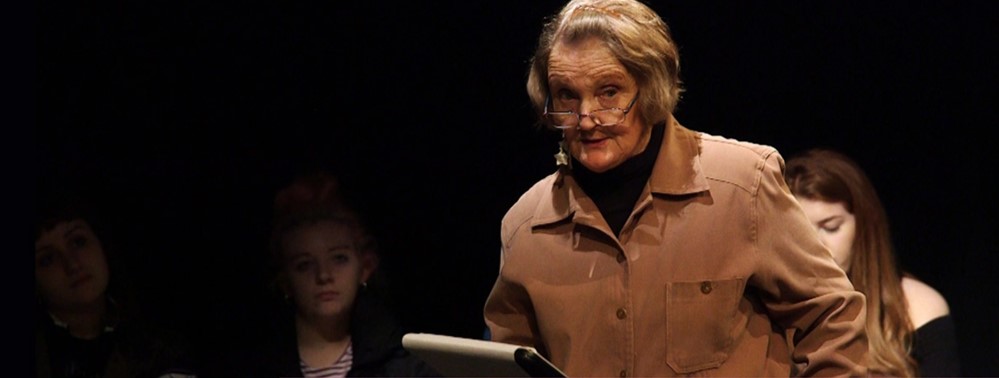
On a wet Thursday May lunchtime Rachel Walker, GOG’s recently retired Worker, and I went to see a play that was part of Leeds International Festival, featuring a GOG Trustee, Ann West. It was a powerful play called “Talkin’ Bout My Generation.” The ages of the Cast ranged from 62 to 89. They had reflected on their lives – so far- and had written down their memories and thoughts which were developed into a script. The Group was founded and directed by Teresa Brayshaw of Leeds Beckett University. The play is also part of a research project.( An article about the play featured recently in the “I” Newspaper and was reviewed very favourably.)

Rachel and I found ourselves sitting in a pew at Mill Hill Chapel in the centre of Leeds laughing, crying, doing arm exercises and hearing about some of the statistics, experiences and hopes of older people.You will find useful statistics in a section of our GOG Parish Pack, and we always learn more don’t we….? We were challenged about some of the stereotypes of us older people, and I left at the end feeling uplifted and energised.

actors in a playI found the performance really powerful. It was skilfully put together: a melding of serious material and fun. It was moving, informative and funny. There was a really appropriate and good use of the church space and it enhanced the performance being told about a William Morris window. a beautiful Italian mosaic (go and see them!), and that a previous minister Joseph Priestley had been the discoverer of oxygen and soda water and had developed his ideas in this very space! The soda water was given to his friend James Cook the explorer to sustain his crew during their next long sea voyage. I had lived in Birstall, Priestley’s place of birth, so I knew about him but not his connection to the church or soda water!

I realised the cast were sometimes saying words written by themselves or one of their colleagues. Which? The question enhanced the performance and diversified the cast as it didn’t matter who had experienced or thought some of the material. Sometimes I knew they were speaking about their own experience, and sometimes I wasn’t sure, which added interest. During a Brexit discussion: were the Remainers having to advocate Brexit and vice versa? Some read their scripts. Some didn’t.Were references to memory being described by those whose memories were failing or not?

I loved the change of tempo when we were invited to do exercises by Ann who in early retirement had run exercise classes for older people. I found one actor’s recalling the passionate kiss of young love with his wife to be and then falling in love with her anew when she was struggling with cancer that proved fatal, very moving. And then he was searching for his words and another actor intervened to help him out. Was that part of the script or not? And when giving the Notices towards the end of the Play the Minister of Mill Hill Chapel spoke about what we would hear. But, hang on, I had already heard it earlier in the play… Was that a ruse? Deja vue? Or had I imagined it? Was it to help us with a summary? Or was it to give something of the experience of confusion memory loss can bring…

I loved being offered a Toast of wine or the aforesaid mentioned soda water! I loved how the actors were being themselves: the animal loving woman who stroked the stone dog lovingly as she walked past the steps to the pulpit; the organ and piano music played exuberantly by a cast member; the academic describing the church; joining in the exercises and singing a rousing song we had been taught at the end of the performance. Finally, we were given a sprig of Rosemary for remembrance.

I am an older person, working with older people and I learned lots and was hugely entertained.Thank you to the cast of Cinage Theatre company and Leeds Beckett University.